> For the complete documentation index, see [llms.txt](https://docs.colt.net/llms.txt). Markdown versions of documentation pages are available by appending `.md` to page URLs; this page is available as [Markdown](https://docs.colt.net/on-demand/user-guides/ports.md).
# PORTS OVERVIEW
> **DO YOU NEED SERVICES WITH EXTRA DIVERSITY/RESILIENCE?** \
> Check out the new port diversity feature [here](https://docs.colt.net/on-demand/user-guides/resilience).
Ports are used to terminate circuit connections. Under the On Demand model, ports are a separate component - unlike the traditional data networking model where ports are an integral part of a circuit connection.
Ports can be ordered on a standalone basis, or be requested as part of an integrated circuit ordering journey.
All on-net, hybrid on-net and nearnet ports are capable of supporting multiple circuit connections, using VLAN tagging. Off-net ports can only support a single circuit as standard (multiple circuits may be available on request).
### MULTISERVICE FUNCTIONALITY
All On Demand ports are capable of supporting multiple service types, using VLAN segregation. Example use cases include:
* Multicloud – multiple cloud connections terminating on the same physical On Demand port at the customer site
* NNI for Ethernet Virtual Private Line – multiple Ethernet connections aggregated on the same physical port for service provider handoff
* Enterprise multi service – internet access, data centre connections and multiple cloud connections to support typical enterprise WAN services
For further details on VLAN configurations supported on the Colt On Demand platorm, please refer to the [On Demand Connections](https://www.colt.net/solutions/on-demand/resources/connections/) section.
### ON DEMAND ACCESS PORTS (ON-NET & HYBRID ON-NET LOCATIONS)
Colt supports a full range of physical 1Gbps, 10Gbps & 100Gbps port specifications:
| Supported 1Gbps physical interfaces | Supported 10Gbps physical interfaces | Supported 100Gbps physical interfaces |
| ----------------------------------- | ------------------------------------ | ------------------------------------- |
| 1000Base-LX | 10GBASE-LR | 100GBASE-LR4 |
| 1000Base-SX | 10GBASE-SR | 100GBASE-SR4 |
| 1000BaseT | | |
Where a 1000Base-T interface is required the port is configured with autonegotiation enabled. Colt does not support the manual configuration of 10Base-T or 100Base-T ports by disabling autonegotiation; autonegotiation is always enabled by default.
In the On Demand portal, ports can be requested as a standalone order or requested as part of the connection order flow. In both cases, the basic process for ordering a port is the same. Ports are requested by first entering the address of the location you wish to connect.
Select a bandwidth and commitment - 12 months in on-net enterprise buildings, 3/12 months in on-net data centres and 12-60 months for off-net and hybrid on-net locations. Then choose a diversity option - please refer to the "Resilience & Diversity" section for further details.

New ports can be requested in the default shared area (e.g. an MMR in a data centre) or in a specific room – for example, the comms room on the third floor of an enterprise building. Customers are encouraged to select the default shared area as the On Demand platform will automatically select ports that are available via near real time delivery.
The On Demand portal shows ports that can be reserved in near real time (flagged as "immediate delivery") and ports that require a network capacity build are shown with the typical delivery lead time.

{% hint style="warning" %}
IMPORTANT! On Demand ports stay in a deactivated state until a circuit connection is added to the port. Customers can request that a new port is tested prior to a circuit being added by raising a ticket via the standard support process.
{% endhint %}
### ON DEMAND ACCESS PORTS (OFF-NET/NEARNET LOCATIONS)
Customers can request connectivity to millions of off-net enterprise office locations globally, via one of our integrated carrier partners.
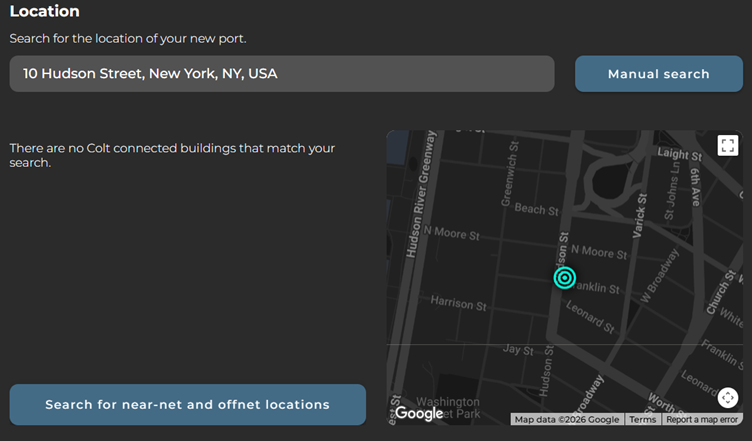
When an address is entered and no on-net buildings are listed, the “Search for offnet and nearnet locatons” option should be selected.
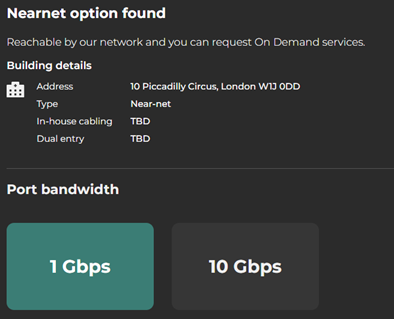
If the location is close to the Colt fibre network, “nearnet” is the default option (where Colt provides new fibre into the building), along with the on-net port bandwidth options (1/10Gbps).
If the location is not close to the Colt fibre network off-net options via one of Colt’s integrated carrier partners will be presented.
Select an offnet port bandwidth (10Mbps-10Gbps) to see the list of carrier partners and contract terms (12-60 months) available at the chosen location.
To order the offnet port, first select the desired option and then enter the physical configuration details (PoP location & interface).
### PORT CHARGES
### ON-NET PORT CHARGES
Under the default On Demand flex pricing model, customers are required to make a 3 or 12 month commitment. Monthly recurring rental charges then apply.
In enterprise buildings, the minimum commitment is 12 months – customers are also charged a small installation fee to cover the cost of adding the new port capacity.
Under the fixed pricing model, customers are not required to make a commitment on the port. Under the fixed model, customers are charged a one off installation fee when a new port is added.
Please refer to the pricing section for more further details.
## OFF-NET PORT CHARGES
Offnet ports are available on 12-60 month contract terms, aligned to the terms of the underling Ethernet circuits from our carrier partners.
Offnet ports attract an NRC and MRC charge.
### REQUESTING A CROSS CONNECT
At data centre locations, customers can order a cross connect directly from the data centre operator, or order from Colt - where Colt manages the cross connect on the customer's behalf.
{% stepper %}
{% step %}
### ORDERING A CROSS CONNECT FROM A DATA CENTRE OPERATOR
At data centre locations, customers are able to generate an LOA from the On Demand portal to grant the Data Centre permission to access the Colt rack to facilitate the termination of DC cross connects.
The LOA should be submitted to the DC operator when the cross connect order is placed. Please note that the LOA can only be generated AFTER the delivery of the port is completed.


{% endstep %}
{% step %}
### ORDERING A CROSS CONNECT FROM COLT
Alternatively, customers can request a fibre cross connect in a data centre via the On Demand platform, which will result in Colt placing a request being placed on the data centre operator for a cross connect between the specified On Demand port and the demarcation point in the customer rack.
When a new port is requested, customers are asked whether a cross connect is required.
Please note that only fibre cross connects are supported - copper cross connects are not supported.

Where a cross connect is requested, customers are required to enter the demarcation details and are also required to upload a letter of authority to grant Colt permission to place a cross connect order to the customer rack. The demarcation details and LOA are mandatory.

{% endstep %}
{% endstepper %}
### CLOUD PORTS
Cloud connections must be terminated on a cloud port - either a hosted cloud port (for services handed over on a shared interconnect to the CSP) or a dedicated cloud port (for services handed over on a CSP port dedicated to a single customer).
Please refer to the [cloud connectivity](https://www.colt.net/solutions/on-demand/resources/cloud/) section for further details.
### CANCELLING A PORT DURING DELIVERY
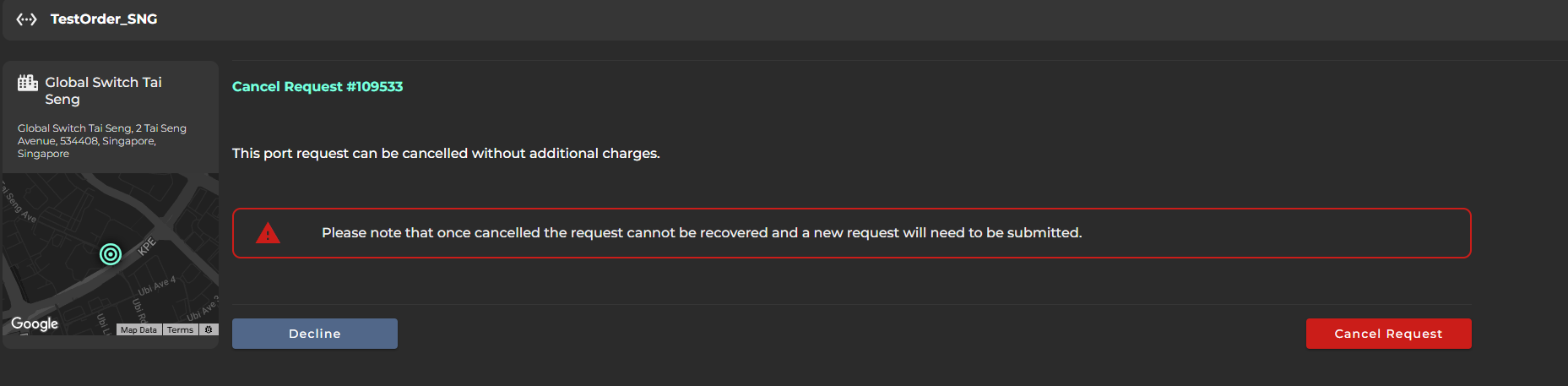
On Demand ports can be cancelled during the delivery lifecycle, i.e. an “in-flight cancellation”. Depending on the delivery stage, a cancellation charge may or may not apply.
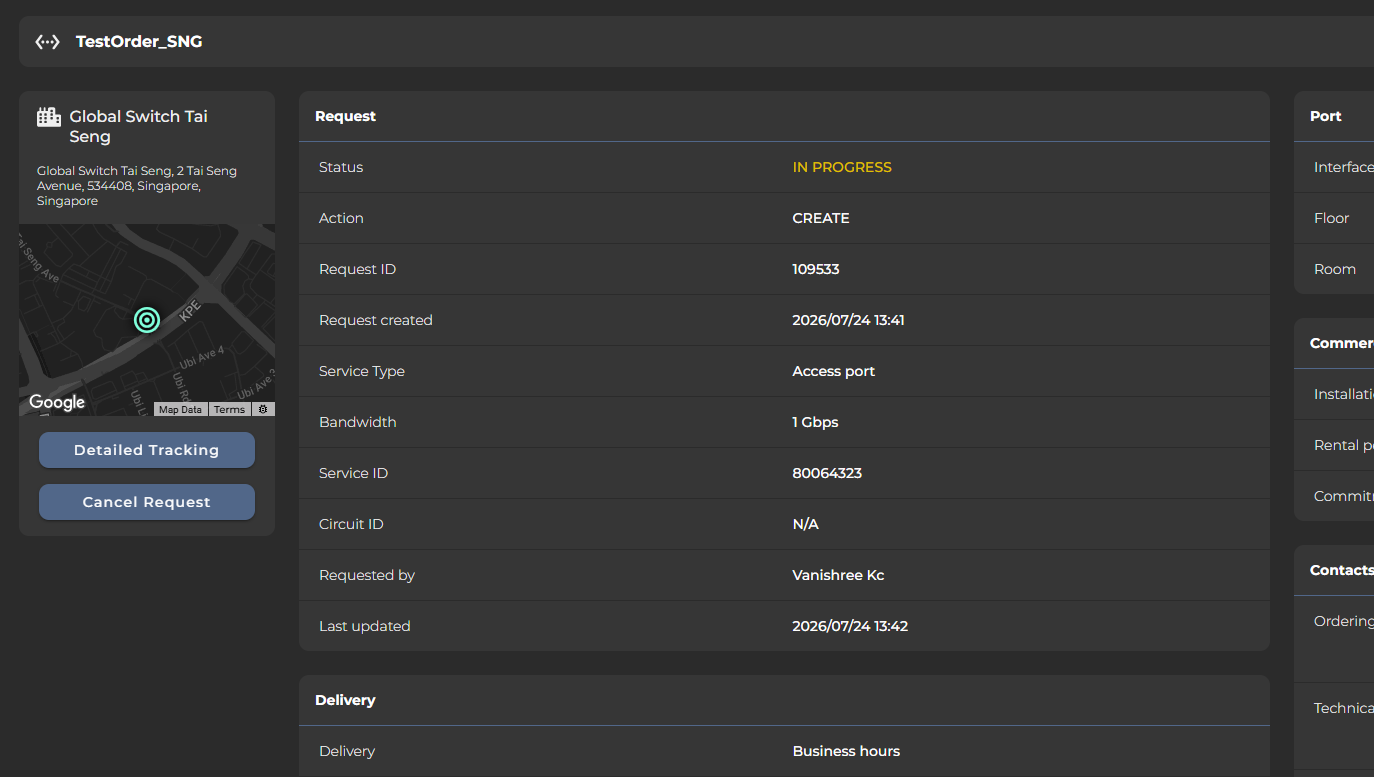
To start the journey to cancel a port that is in delivery, the “Cancel Request” option should be selected.
Where the delivery is in an early stage and no penalty charges apply, the port can be immediately cancelled.
Where the delivery is at a more advanced stage, charges may need to be applied. To obtain the cancellation charge, the “Request Price” option should be selected and an email will be sent showing the penalty charge for in-flight cancellation.
IMPORTANT NOTE: selecting this option puts the delivery request on hold for 5 business days, or until the request is declined.
Once the penalty charge for in-flight cancellation has been received, the request can either be:
* Cancelled – the “Cancel Request” option should be selected to cancel delivery of the port. Any circuit connections attached to the port (in a WAITING state) will also be cancelled. The circuit cancellation is included in the penalty charge for the port cancellation.
* Declined – the “Decline Request” option should be selected to decline the caancellation and recommence the portdelivery
If no action is taken, after 5 working days the port will be put back into delivery.
### **WANT TO LEARN MORE ABOUT ON DEMAND?**
**A guide to On Demand**
Colt On Demand supports point to point connections between data centres and enterprise offices, private connections to the public cloud and internet connectivity. Visit the On Demand solution page to discover more about On Demand and how it can help you find the right pathway for your business.
[Discover On Demand](https://www.colt.net/solutions/on-demand/)
Questions? We're here to help.
Speak with one of specialists today. We’re here to offer advice, provide further information and to answer any queries you may have.
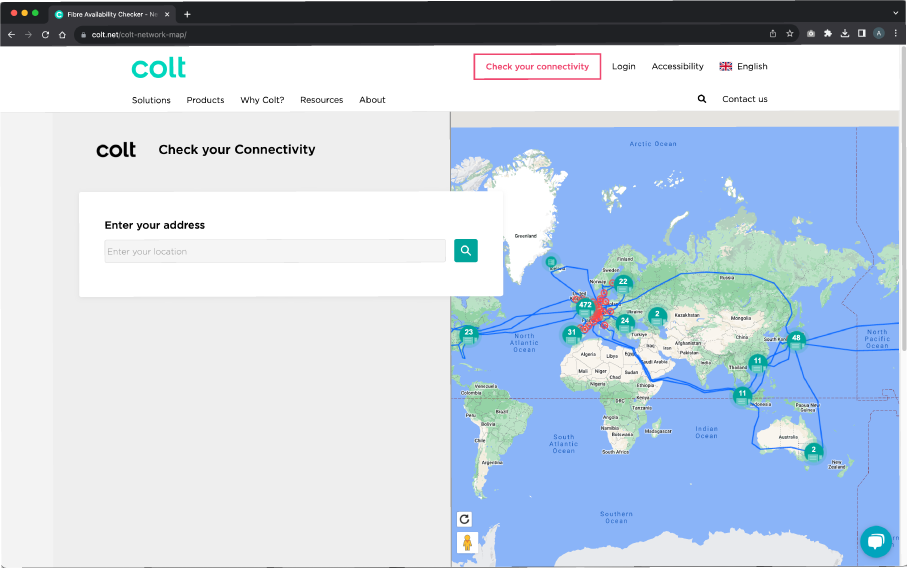
[Check your connectivity](https://www.colt.net/connect/)
---
# Agent Instructions
This documentation is published with GitBook. GitBook is the documentation platform designed so that both humans and AI agents can read, navigate, and reason over technical content effectively. Learn more at gitbook.com.
## Querying This Documentation
If you need additional information that is not directly available in this page, you can query the documentation by asking a question.
Perform an HTTP GET request on the following URL with the `ask` and `goal` query parameters:
```
GET https://docs.colt.net/on-demand/user-guides/ports.md?ask=&goal=
```
`ask` is the immediate question: it should be specific, self-contained, and written in natural language.
`goal` is what the user is ultimately trying to achieve, the reason they need the answer. Sharing it helps GitBook give you a better, more relevant answer. A goal is most helpful when it describes the outcome the user wants rather than restating the question. For example, with `ask=how do I create an API token`, a goal like `automate deployments from our CI pipeline` lets GitBook tailor the answer to that use case.
The response will contain a direct answer to the question and relevant excerpts and sources from the documentation.
Use this mechanism when the answer is not explicitly present in the current page, you need clarification or additional context, or you want to retrieve related documentation sections.
.png)
.png)

.png)